
Crop guide
Pulses nutrition
Nutrient needs, growth stages, common deficiencies and why nutrients go missing in lentils, chickpeas and faba beans.
Nutrient needs
Pulses fix their own nitrogen through rhizobia bacteria in root nodules. Good nodulation depends on the right inoculant for the species, a soil pH that suits the crop, and enough phosphorus. Large amounts of fertiliser nitrogen can reduce nodulation, so pulses usually need little or none beyond what is in the seeding fertiliser.
Phosphorus supports early growth and nodulation. Zinc is often short on alkaline soils. Molybdenum is needed for nitrogen fixation and can be short on acidic soils. Lentils, chickpeas and faba beans generally prefer neutral to alkaline soils, and subsoil constraints such as salinity and boron toxicity can limit them on some alkaline soils.
Pulses also leave nitrogen and a disease break for the following crop, which is part of their value in the rotation.

Key nutrients
Growth stages and when nutrients matter
-
Stage 1
Sowing and establishment
Each pulse species relies on its own strain of rhizobia, usually supplied as an inoculant. Rhizobia are sensitive to heat, drying and some seed treatments. Phosphorus, and zinc where needed, are applied at sowing.
-
Stage 2
Early vegetative growth
Nodules form and start fixing nitrogen. Pale plants at this stage can point to poor nodulation rather than a fertiliser shortfall.
-
Stage 3
Flowering and pod set
Nutrient and water demand peaks. Stress here costs pods and seed.
-
Stage 4
Pod fill
Nutrients move into seed. The crop residue and roots leave nitrogen for the following crop.
Common deficiencies and signs
Symptoms of different problems can look alike. Disease, herbicide damage, waterlogging and frost can all produce signs similar to a deficiency.
| Nutrient | What to look for | Where it is more likely |
|---|---|---|
| Nitrogen (poor nodulation) | Pale, yellowing plants with few or white nodules instead of pink, active ones. | Paddocks with no recent history of the crop, acidic soils or poor inoculation. |
| Phosphorus | Small, slow plants with dark leaves and poor nodulation. | Low-phosphorus soils and soils that tie up phosphorus. |
| Zinc | Small, pale or bronzed leaves and stunted growth. | Alkaline and calcareous soils. |
| Manganese | Interveinal yellowing on younger leaves. | Alkaline sands and loose seedbeds. |
| Molybdenum | Pale plants similar to nitrogen deficiency, because fixation is reduced. | Acidic soils. |
What deficiencies look like in pulses
Photos of deficiency symptoms. Where we do not yet have a suitable photo, we will add our own trial photo. Symptoms vary with crop, variety, soil and season.
-
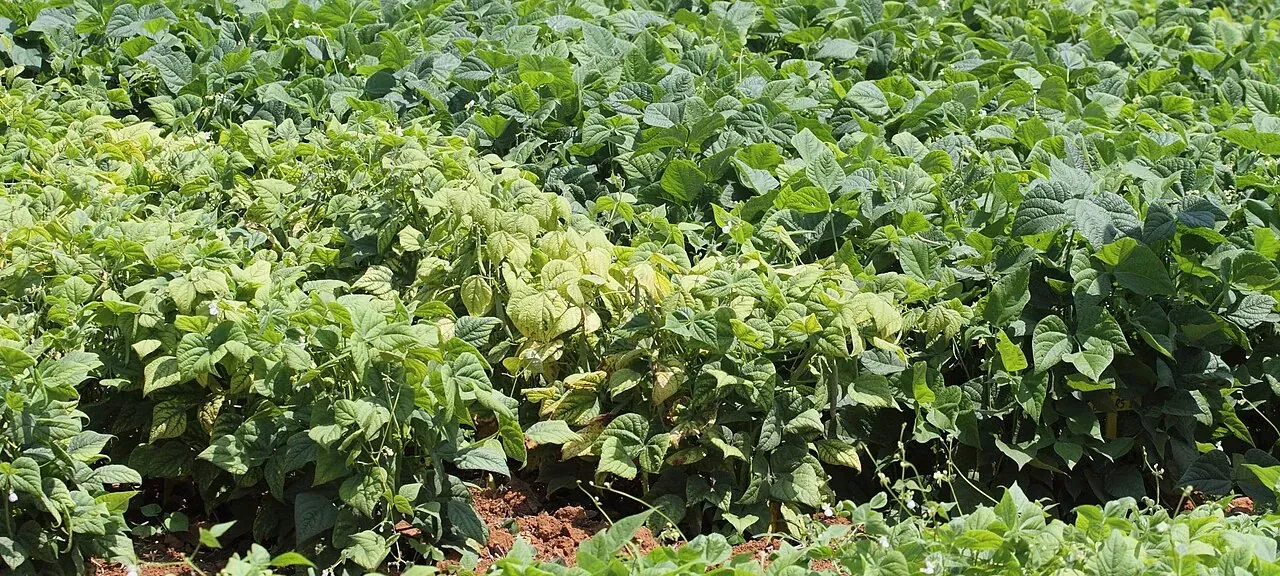
Potassium deficiency in dry bean, a pulse: two varieties on the same low-potassium soil, one showing severe yellowing. Photo: Alandmanson, CC BY-SA 4.0, via Wikimedia Commons. -
Photo coming soon: LCF trial photo
Deficiency symptoms in chickpea, lentil or faba bean. We will add our own trial photo here.
Photos may show other crops with the same symptom. Full credits: Image credits.
Why nutrients go missing
Not everything applied to a pulses crop ends up in it. These are the main ways nutrients are lost or become unavailable.
- Reduced nodulation
- When plenty of nitrate is available in the soil, pulses form fewer nodules and fix less of their own nitrogen. Acidic soils reduce rhizobia survival and molybdenum supply, which also limits fixation.
- Phosphorus fixation (lock-up)
- Phosphorus reacts with calcium in alkaline soils, and with iron and aluminium in acidic soils, forming compounds plants cannot easily use. It also moves very little in soil. Calcareous soils and soils with a high phosphorus buffering index (PBI) bind more of it.
- Trace element lock-up
- At high soil pH, zinc and manganese form compounds of low solubility, so calcareous and alkaline soils can hold these elements yet supply little to the crop. Cold, wet soils slow root activity and uptake further.
- Subsoil constraints
- On some alkaline soils, salinity and boron toxicity in the subsoil restrict root growth, so roots reach less of the water and nutrients below.
- Seed-row effects
- As urea dissolves next to the seed it releases ammonia, which can damage germinating seed. The effect is stronger with wider rows, narrower openers, sandy soils and dry seedbeds. Pulses are more sensitive than cereals to fertiliser in the furrow.
LCF offers fertiliser technology matched to your use case, whether that is drilled urea or top dressing before or after planting. Advanced inhibitor technology is added in the compounding process at our manufacturing partner Lardmee (LDM).
How LCF products fit
LCF Australia supplies compound fertilisers made by our manufacturing partner Lardmee (LDM), including Urea Plus and zinc and manganese sulphates, on enquiry. We also supply the Field Spears soil testing kit, which reads soil N, P, K and pH in the paddock. Which product suits, how much and when depends on the soil, the crop, the season and how you apply it.
-
Micronutrients and sulphates
Zinc sulphate, manganese sulphate and other nutrients for growers and liquid-fertiliser manufacturers. Supplied on enquiry.
View Micronutrients and sulphates -
Humate compound fertilisers
Our manufacturing partner Lardmee (LDM), an independent company in China, makes compound fertilisers that include potassium humate. Ask us about products and availability.
View Humate compound fertilisers -
Other fertilisers by enquiry
Granular urea and other fertilisers. Name the product and the quantity and we will tell you what we can supply.
View Other fertilisers by enquiry